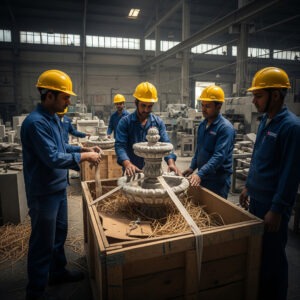
Packaging Unit
RELIABLE PACKING PROCESS FOR A SAFE TRANSIT
Stone Sculpteur understands what buyers expect when it comes to packing dimension stones, such as granite and marble. That is why we give prime importance to stone packing with the utmost care. Though stones are pretty hard in nature, they are susceptible to damages during several phases of loading, unloading, and long road/sea transportation. Right from the time of loading at the factories until their unloading at the clients’ site, stone products are subjected to harsh treatments as they cover thousands of miles through rough sea routes. It, therefore, becomes imperative to focus on stone packing for safety, which ensures their intact deliveries at a desired location around the world. We use the following packing materials for the extra safety of stone products.
OUR 3-STEP PACKAGING PROCESS
It is our constant endeavor to deliver quality products to our clients which encourages us to focus on quality at every step of project completion including packaging. From the initial crate preparation to packaging the product, our comprehensive and meticulous approach to natural stone packaging ensures the final delivery of the consignment in an untouched condition.
So, let’s take a look at the various steps of the packaging process of natural stone tiles adopted at Stone Sculpteur.
SEAWORTHY CRATE PREPARATION
We begin with highly reinforced wooden crates made from solid eucalyptus wood for strength and flexibility. The inner surfaces of each crate are lined with polythene and foam sheets on all sides to cushion the stones and protect edges from impact or friction.
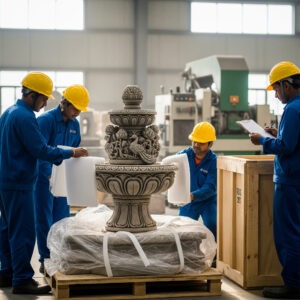
SYSTEMATIC STONE PLACEMENT & FILLING
Natural stone tiles are placed in a structured pattern to optimize space and minimize movement. Tiles are packed tightly to prevent shifting, and any gaps are filled with foam sheets to secure surfaces and edges from damage during handling or transit.
SECURING, TREATMENT & FINAL SEALING
Once filled, the crate is topped with additional foam and polythene layers. The crates are chemically treated and fumigated before dispatch. Finally, the crate is sealed with nails, wrapped externally with polythene for weather protection, and secured with packaging straps from all sides.